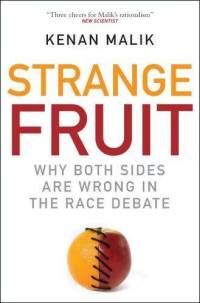
Race is a contentious issue. Is it biological? Is it cultural? Is it merely a historical vestige in a post-racial society? The recent adoption by the state of Arizona of a palpably racist anti-immigrant law indicates how inflammatory, and important, this issue remains.
Kenan Malik has situated himself in the crosshairs of the dispute over the nature of race, arguing from the standpoint of Enlightenment rationalism and scientific objectivity. His book, Strange Fruit: Why Both Sides are Wrong in the Race Debate, was long listed as the British Royal Society’s 2009 science book of the year. It is a wide-ranging polemic against those who claim that race is a biological fact. Continuing the investigation begun in his 1996 book The Meaning of Race, the new volume takes special aim against multicultural postmodernists and examines the biological, social and historical premises behind identity politics.
Malik points out that identity politics mimics racism itself. The two outlooks, he emphasizes, share the claim that one’s political, social and cultural viewpoints should derive from one’s sex or ethnic identity. Liberal thinking, he says, has become infected with a racial view of the world. 'Out of the withered seeds of racial science have flowered the politics of identity. Strange fruit, indeed,' he observes.
Malik studied neurobiology and the history and philosophy of science, and was a research psychologist. This multidisciplinary approach permeates his writing. What is most significant is that he places the sciences and their interpretation in a historical context and, most unusual of all, in a political context. This book provides a compelling argument that race is not a scientific category, but a social one. He goes further to characterize the promotion of affirmative action and identity politics as the rejection of scientific universality and the 'embrace of irrationalism as a political strategy', a critique thoroughly welcome for its breadth.
Strange Fruit begins with Nobel Laureate James Watson’s 2007 controversial statement: 'I am inherently gloomy about the prospect of Africa… All our social policies are based on the fact that their intelligence is the same as ours - whereas all the testing says not really,' he declared. Watson, together with Francis Crick, unraveled the structure of DNA; he also was the director of America’s Human Genome Project. His shocking statement, Malik suggests, was emblematic of the tenacity of racial thinking, even among scientists, and pointed to the fact that science alone cannot determine the veracity of race.
There are three main aspects to the book: an account of the biological dispute on the existence of race, its reverberations among cultural anthropologists, and the place of race socially, historically and philosophically.
Malik examines a range of positions on the biological nature of race. He quotes the pioneering evolutionary biologist Ernst Mayr, 'If the average difference between two groups of individuals is sufficiently great to be recognizable on sight, we refer to such groups of individuals as different races', and describes him as a 'race realist'. Mayr strenuously rejected typological definitions of race, but nonetheless struggled with the concept and concluded that races existed not only in man but in two-thirds of all species of plants and animals.
Statistical population studies in genetic difference are now the standard. While most biologists refuse to use the word 'race' in their studies, some persist. Strange Fruit cites biologist Alice Brues who defines race as 'a division of a species which differs from other divisions by the frequency with which certain hereditary traits appear among its members.'
The perplexity of melding commonly held racial definitions with identification of race by genetic markers is the rub, the author demonstrates. For example, he points to sickle cell disease, one of most well-known 'black' diseases. As sickle cell disease originates in areas where malaria is prevalent, it is found in equatorial Africa, parts of southern Europe, southern Turkey, parts of the Middle East and in much of central India. Four distinct types of sickle cell genes have been discovered across continents, says Malik. Scientists are forced to conclude that genetic traits based on ancestry do not necessarily conform to the self-identified race of various populations.
The author also points to the work of Neil Risch, a professor of human genetics at University of California, who argues that if races are defined according to the greatest degree of genetic difference, there should just two races, sub-Saharan Africans and others. Along the same lines, geneticist Jurgen Naggert comments, 'These big groups that we characterize as races are too heterogeneous to lump together in a scientific way. If you’re doing a DNA study to look for markers for a particular disease, you can’t use "Caucasian" as a group. They’re too diverse.' One way around this dilemma is the common designation of 'continental' groupings as races, based on ancestry and migration patterns. These continental categories - Asian, African, American, European and Oceanic - express the complexity of mankind’s migrations out of Africa.
Yet even these continental categories, Malik says, have been deemed too broad for research purposes and therefore are typically divided into clusters. Studies of this type, cited by the author, have linked peoples as dispersed as Armenia, Norway, Ashkenazi Jews, the majority of Ethiopians and a minority of Afro-Caribbeans into one genetic cluster - indicating the problems with customary racial designations.
Malik’s survey demonstrates that, while it is incontestable that genetic differentiation between populations exists throughout the world, scientists differ on the significance attributed to these variations. At what point are variations in characteristics 'inter-racial' rather than indications of racial differences? There is no set of characteristics upon which scientists can define each publicly accepted race. Alternatively, a plethora of 'races' can be genetically defined, which may or may not correspond to social perception or self-identification. Race appears to have validity only if we are willing to be deliberately vague as to what it constitutes, argues Malik.
At the same time, Strange Fruit concludes that the classification of genetic differences between human populations can be helpful in the scientific study of disease, as can ancestry information based on racial self-identification. But Malik emphasizes that use of these imprecise and vague racial categories does not just distort biomedical information, but may often do more harm than good.
In 2005, the US Federal Drug Administration granted the first race-based drug, BiDiL, for treatment of congestive heart failure for African-Americans. BiDiL was denied a license in 1996 because clinical trials demonstrated that it was not effective. After it was reassigned to a race-based study and relabeled for African-Americans, it won a new patent and was put on the market. The studies demonstrated a statistically significant benefit when restricted to those who self-identified as black.
The bottom line, the author points out, is that by marketing the pharmaceutical as a 'black drug', it will be prescribed for many who genetically cannot respond to the drug, while others who could benefit will be denied it.
The concrete effect of upholding the biological notion of race in medical research, Malik says, is that scientists endow differences between socially defined groups with greater importance than is warranted. At the same time, he holds out the hope that pragmatic use of the social, rather than scientific, categories of race could assist medical research. This latter position seems rather self-contradictory for the author.
However, when it comes to the political trend of multiculturalism and its fixation on race, Malik’s attack is unflinching. He is deeply disturbed by the position that the scientific method is a 'local Western approach' or 'a culturally-specific way of knowing', a position that evolved as racial thinking gained left-leaning adherents.
Demonstrating multiculturalism’s chilling effect on science, he details the events surrounding the 'Kennewick Man', a 9,500-year-old skeleton found in 1996 near Kennewick, Washington state. These bones are some of the oldest ever found in North America. However, following the guidelines of the Native American Graves Repatriation Act, passed in 1990, the US Army Corps of Engineers decided that Kennewick Man would be given to the Umatilla tribe for reburial. This 'culturally correct' law was meant to restore 'wrongs done to aboriginals' and requires federally funded institutions to return human remains and objects found in Native American graves to their original owners.
Leading anthropologists from across the country filed suit in an attempt to preserve the bones for science. But the Native American tribes felt this would desecrate their ancestors. An extraordinary legal battle ensued between anthropologists, the US government and the Yakama Indian Nation. Sadly, in April 1998, the US Army Corps of Engineers covered the riverbank where the Kennewick Man had been discovered in 600 tons of rocks, upholding what tribal leaders called the preservation of their culture.
This is not an isolated case. In 1999, Malik reports, Harvard University’s Peabody Museum of Archaeology repatriated the remains of more than 2,000 individuals to the Pecos and Jemez Pueblo tribes in New Mexico. This collection had been considered extremely valuable because it was well preserved and large enough to be statistically significant and demographically representative.
The bones had been the basis of a landmark study on osteoporosis. It is now a resource lost to science. Other museums, among the most prestigious in the world, which gave up portions of their collections include the Smithsonian Institute, the Manchester Museum in Britain, and the American Museum of Natural History.
Cultural repatriation is an example of the growing and reactionary practice of rooting culture in blood or race, rather than speaking to universal truths and civilization as a whole, the author points out. It is a repudiation of the legitimacy of museums, the Enlightenment project of collecting objects for the purpose of science and knowledge, and the collective project of increasing the knowledge of mankind, he concludes. The embrace of these positions by postmodernist academia is deeply reactionary and Malik draws out its implications.
How did society become racialized? This is the most complex of the questions Malik tackles.
For most of human history, the concept of race simply did not exist, at least in the way we think of race today. Malik turns to Ivan Hannaford and his exhaustive study Race: The History of an Idea in the West to demonstrate this historical contrast. While the Greeks classified peoples of the world by skin color, they rejected a racial worldview in favor of a political and civic one, Hannaford asserts. For the Greeks, the key social distinction was between citizens and 'barbarians'. Even in the Middle Ages, Hannaford emphasizes, the main issue with regard to strangers was, 'Do they possess a rule of law', 'Do they act like us?' What defined a person was his or her relationship to law and to faith, not biology or history.
Hannaford’s conclusion is not cited by Malik, but is worth noting. He emphasizes that racial and political thought are two opposed approaches to social organization. He goes further to characterize political thinking as 'inherently and logically resistant to the idea of race as we understand it.' He states that race is 'inimical to Western civilization in the strict sense of the word', and that ethnicity is an idea introduced in modern times that gained importance only in proportion to the decline in political thought (emphasis in the original). Both writers concur that the word 'race' may have been in use for a long time, but its modern meaning has not. As man’s social organization has evolved, the imputed content of 'race' has taken on very different significance, a point often not understood.
Like Hannaford, Malik provides a survey of the development of racial categorization, tracing the role of various schools of thought from romanticism to positivism and postmodernism, as well as a whole range of thinkers from the German philosopher Johann Gottfried von Herder through the founder of cultural anthropology, Franz Boas.
However, Malik takes strong issue with Hannaford, and many postmodernists, when they blame both the Enlightenment in general and its adherents among more modern scientists such as Carl Linnaeus and Charles Darwin for creating and perpetuating racism through taxonomy. Malik does not dispute the rise of such trends as 'scientific racism', as developed by Johann Friedrich Blumenbach, but he emphasizes that the Enlightenment’s attitude toward human difference was permeated by the revolutionary ideas of social equality and the perfectibility of man. The predominant view of that revolutionary period was that human variation, physical or cultural, represented differences not in kind but in degree.
Darwin and the majority of the scientists of his age embodied this spirit. In fact, the fundamental philosophical orientation of racial theory - which assumes the fixity of characteristics- ran entirely counter to natural selection, as Malik notes. For the misnamed 'social Darwinists', struggle eliminated the impure specimens of the race to perpetuate the ideal type. Darwin, on the other hand, dismissed the idea of an ideal type of a species as nonsense.
However, when the Enlightenment’s ideals of liberty, equality and fraternity were not realized following the French Revolution, when social inequality continued and worsened despite the developments of science, the tendency developed to explain poverty and other social ills in racial terms, as though they were somehow natural.
As for the common theory that racism, at least in the New World, evolved directly from slavery, Malik notes, 'As a biological theory, 19th century racial thought was shaped less by the attempts of a reactionary slave-owning class to justify privileges than by the growing pessimism among liberals about the possibilities of equality and social progress.' C. Vann Woodward argues similarly in his groundbreaking book The Strange Career of Jim Crow in which he points to the loss of support for Radical Reconstruction by Northern liberals as a decisive factor in the rise of Jim Crow segregation.
Malik also states that in Victorian England 'race' was considered a description of social distinctions rather than a skin color. With social degradation developing alongside intensified exploitation in British industry, the existence of classes began to be interpreted as hereditary.
Malik concludes that race did not cause inequality, but that the persistence and growth of inequality provided the basis for the growth of racial thinking. This profound point, well worth emphasizing, is at the center of his prior volume, The Meaning of Race. This truth needs to be firmly grounded in historical analysis, and both Malik’s and Hannaford’s summaries tend to give heavy weight to the views of a long series of intellectuals without fully connecting this history of ideas with the social relations and the class struggle. At times, this line of argument conflates the naïve fears of those at the bottom of society with deliberate state policy decisions at the top.
In The Meaning of Race, Malik says that the preoccupation with race at the turn of the 20th century reflected the concern for social stability, the fear of working class unrest, the growth of national rivalries and the emergence of imperialism. Unfortunately, he does not return to this point in Strange Fruit.
While there are many complex intellectual strands that influence the rise of ideas, at bottom they reflect the movement of social forces. At critical historical junctures, certain ideas are “selected,” or found to express the interests of social forces, particularly those of the dominant class. 'The ruling ideas of each age have ever been the ideas of its ruling class', said Karl Marx in the Communist Manifesto.
As a book emphasizing the implications of racial thought for science, Strange Fruit lays less emphasis on this relationship between rise of ideologies and class forces than Malik’s prior work. Nevertheless, the growth of racism historically did not reflect the state of biology. It was the reverse - biology was often interpreted in the service of prevailing social interests, a point he himself refers to.
The origins of racist ideology were complex and multifaceted; the ruling classes seized upon this outlook repeatedly to try to control rising class tensions using Jim Crow in the US in the aftermath of the rise of organized working class, anti-Semitism in Europe, particularly in France and Russia for the same reasons, and various formats around the world, such as 'White Canada' and 'White Australia'. Moreover, the persistence of this racial ideology, although sometimes transformed into various culturally or politically correct formulations, expresses the continued need to suppress the class contradictions within modern society.
In conclusion, Malik returns to the reactionary impasse of identity politics and multiculturalism. In a very valuable section, he indicts the postmodernists for their inability to confront the problem of social inequality and their pessimism, pointing to the role of the New Left and the Frankfurt School. He denounces the viewpoint that the Holocaust was rooted in the Enlightenment, as well as the position of post-World War II radicals who despaired of the role of the working class. As he correctly puts it, the New Left turned to surrogate proletariats - Third World liberations struggles, feminists, etc. - while its supposed anti-racism turned against rationalism and all that was progressive in the Enlightenment.
'What is lost in this dichotomy between biological universals and cultural difference', Malik excellently summarizes, 'is the sense of human agency; that is the existence of humans as rational, social beings with the power to transform themselves and their societies through reasoned dialogue and activity. All animals have an evolutionary past. Only humans make history… Humans are able both to create social distinctions (and to view them as natural or fixed) and to ignore natural differences (as irrelevant to social intercourse).'
Malik’s resounding appeals to humanism and reason are appropriate; however they are an inadequate antidote to modern racial thinking. The only thoroughgoing and consistent antiracism is based on internationalism and socialism, that is, Marxism, which is a scientific development over the humanism and rationalism of the Enlightenment. Malik’s disillusioning experiences with the New Left in Britain only express, in another way, the fact that Trotskyist internationalism represents the living opposition to all forms of postmodernist identity politics.
Strange Fruit is to be welcomed, nonetheless. It is a serious contribution to the clarification of a complex issue.
Malik gives a sensible analysis of what I think will be one of the biggest issues in public science in the coming years: race. On the one hand, geneticists tell us that there is no such thing as a genetic basis for race. On the other, doctors and scientists are increasingly finding genetic differences between geographically separated human populations. Malik steers a careful, eloquent course in this minefield: race, he argues, might be a socially constructed concept, but that does not render it a fiction. He exhorts us to “drop the pretence” that it doesn’t exist; such colour-blindness stokes, not dampens, racism. Malik’s work is an idealised manifesto for goodwill to all men, whatever their hue.
It's exciting when someone promises to show how both sides of an argument
are wrong. Kenan Malik's position, in short, is: 'Race is not a rational,
scientific category. Anti-racism has become an irrational, anti-scientific
philosophy.' To defend the first statement he embarks on a lucid discussion
of modern population genetics and medicine, then hops back to the 18th century
to begin a historical survey of ideas about 'race'. There are some curious
blips (it is weird to call David Hume 'doggedly mainstream') and some pleasing
new angles - for example, Malik's point that phrenology was originally welcomed
as a progressive idea, 'because it suggested a practical way of improving
one's lot' through brain training.
Where it all goes wrong is with the Nazis, and the subsequent idea among Malik's
opponents on the anti-racist left that Hitlerian eugenics and genocide grew
out of too much reason, rather than too little. 'The fight against barbarism
turned into a war against the Enlightenment', Malik writes. In our day, he
concludes, the tendency of 'celebrating racial identity' is predicated on
the same assumptions of racial difference as those held by racists themselves,
and a kind of 'intellectual apartheid' is among the results. A nicely provocative
and stylish polemic.
In this book, which is tough but ultimately rewarding, Kenan Malik tells
us that 'both sides are wrong in the race debate'. On one side are the people
who believe that there are such things as races - and who therefore prepare
the ground for racists. They are wrong, says Malik. There's no such thing
as race.
He takes issue with some antiracists, too. 'The concept of race is irrational,'
he says. 'The practice of antiracism has become so. We need to challenge both,
in the name of humanism and of reason.'
Malik is right when he says that race, as an absolute concept, is flawed -
groups of human beings are fluid entities, fuzzy around the edges, rather
than static populations. Prehistoric tribes colonised the areas they lived
in, until the terrain could no longer support their growing numbers. At these
crisis points, people broke away, looking for food and shelter elsewhere,
and adapted to the different conditions they encountered. So they began to
look different - and, some scientists say, think differently. That's evolution
in action. But it is very difficult to say where one race ends and another
begins. The trouble, according to Malik, is that, even though race may not
be real, it is a powerful fantasy - and often a malign one.
The idea of race probably started in the Stone Age, or even earlier, when
antagonism towards different tribes, and altruism towards the members of your
own, helped you to pass on your genes. So a belief that groups of human beings
are different might be hardwired. And naturally, you would believe in the
inherent superiority of your own tribe, wouldn't you? So for thousands of
years, it has been impossible to separate the belief in racial difference
from the belief that some people are essentially better than others.
Malik tells the history of those who wanted to demonstrate the differences
between races. There was Jacob X, a French army surgeon, who, a century ago,
'set out, in the name of science, to handle testicles, measure labia and record
a thousand sexual peccadilloes'. He believed that black men had smaller testicles
than white men, and also that their 'erection is never hard like that of the
European, the Chinese and the Hindoo. It is always rather soft and feels to
the hand like a strong elastic tube of India-rubber.'
Then there is J. Phillipe Rushton, who divides humanity into three races -
Orientals, Blacks and Whites. Rushton believes that orientals are the brightest
race, and blacks the least bright. 'Distilled down,' Malik writes, 'Rushton's
thesis comes to this: big penis, small brain, pretty stupid; small penis,
big brain, very clever.'
Malik also mentions The Bell Curve, the bestselling book by Charles Murray
and Richard Herrnstein, which pointed out that black people, among other minorities,
were failing to thrive in modern, meritocratic America. This, the authors
thought, was at least partly because black people had lower IQs than other
groups. But now this theory seems to be nonsense, partly because IQ tests
are biased against minority groups, and partly because modern America is,
in fact, far from meritocratic.
But the problem, says Malik, is more complicated than you might think. It's
not just that 'race-realists' want us to believe that there are such things
as human races, and that they are immutable. The antiracists have a problem
as well. These days, he tells us, it is 'difficult to distinguish between
the racist and the antiracist'. Take the case of James Watson, the Nobel laureate
who effectively ended his career when he said that, when it comes to intelligence,
research demonstrates that Africans do not have 'the same as ours'. Watson,
says Malik, 'got his facts in a double helix'. What, for instance, does he
mean by the blanket term 'Africans'?
But some of his critics were also wrong-headed. The Ghanaian writer Cameron
Duodu, for instance, wrote that: 'It is quite stupid to expect total efficiency
from a people who are being torn in two directions at the same time - between
an inherited, ancient culture, and a modern, imported one.' In other words,
as Malik puts it, 'Africans are different. Modernity is alien to them. They
don't need a high IQ for the kind of lives they lead. Even Watson might have
blanched at describing Africans in this fashion.'
So we're in trouble. For one thing, we might be hardwired to believe in the
concept of race, even if it doesn't exactly exist. So whenever people start
to look for differences between human populations, it brings out the worst
in us. And then, of course, research in this area is not the most rigorous
- institutions aren't exactly throwing money at it, so it won't attract the
best scientists. And on top of all of this, antiracists have graduated from
a belief that race is a poisonous fantasy towards a belief that it is a solid
reality. It is all a great pity, not least because, as Malik says, looking
at 'real genetic differences between human populations' can be a useful thing.
My feeling is that racial information is rather like information about gender
and sexual orientation: the best scientific work will be done only when true
equality looks like being a possibility. Which might be some time.
It's hard to think of a more fraught issue for contemporary society than
race. It’s become taboo: the wrong word can lead to social opprobrium
but unspoken racial distinctions still lurk in the background. Kenan Malik's
gloriously sharp and combative new book, Strange Fruit, Why Both Sides
Are Wrong in the Race Debate, cuts through the cant and confusion that
so often surrounds this issue.
Malik starts out from the seemingly obvious, but clearly still touchy observation
that there is genetic variation across human populations. This is beginning
to have an impact on medicine, most famously in the case of BiDil, the anti-heart
disease drug marketed explicitly for African Americans. But as Malik demonstrates,
variation can't be crystallised into any rigorous scientific category that
resembles a 'race'.
Commonly understood 'races', such as Hispanics in the US, are in fact often
multi-origin groups. Those from Mexico, Cuba or Puerto Rico have different
frequencies for different genes, alongside varying proportions of mixed Native
American, European and African stock. But continental and national groups
are equally spurious scientifically: no matter how you cut it, you can always
find a populational genetic difference. Even the racial prescription of BiDil
isn't a perfect guide since skin colour is merely a 'biomarker' for a higher
chance of having a particular genotype. Race is a pseudo-scientific set of
assumptions about human difference that has its basis ultimately in society,
at best a 'social representation of certain aspects of genetic variation'.
So if there's no genetic reality to race, where does the idea come from? Rather
than blame evolved human nature or insurmountable cultural chauvinism for
why people group 'others' as they do, Malik takes a sweeping historical view
of changing ideas about human difference, an analysis familiar from his earlier
work, The Meaning of Race.
In medieval Europe, there was no real idea of race. Identity wasn't rooted
in biological terms, but in cultural ones of 'faith' and 'law', with an imagined
bestiary of monsters taking their place in the 'great chain of being' along
with God and the angels. The medieval understanding of humanity was a rather
confused affair, and Europe had a strange relationship with outsiders, where
the same black man could be a prince in Portugal, and a useless slave in Africa.
The undoubted brutality of the pre-modern era was not racialised in any modern
sense; in fact black people were sometimes associated with regality since
one of the Magi was traditionally depicted as black.
This worldview was challenged by the revolutionary humanism of the Enlightenment,
when human beings could for the first time be conceived unique, unified and
equal. But the political revolution of the Enlightenment was accompanied by
the bourgeois economic revolution and the advent of capitalist production,
which reinforced endemic inequality between individuals and classes within
society. How could the circle of an ideological commitment to human equality
and meritocracy be squared with an economic system that entrenched inequality
and social immobility? By naturalising that social, class inequality into
a biological, racial inequality; not amenable (they hoped) to the revolutionary
solutions on offer at the time - or as Malik quotes Condorcet, by making 'nature
herself an accomplice in the crime of political inequality'.
Malik expertly picks out the competing and interacting strands of radical,
moderate and reactionary thought that went into creating the modern world.
It hasn't always been the usual suspects who opted for racial thinking: scientific
racism appealed more to Northern liberals than Southern slave owners in the
US, who always invoked the authority of the Bible to justify their rule. Its
scientific airs attracted those impressed by pseudo-rational justification
- an association which would go on to do science some damage.
Interestingly, he shows how race hasn't always been the (literally) black
and white issue it seems today. The origins of much racial thinking actually
lie with class divisions within the West, where the working classes are seen
as a 'race apart', and the discourse of biological difference developed at
home is later applied abroad. Malik gives the example of Lady Gordon, who
explained that her white nurse was perplexed by her treating high status Fijian
women as her equals: 'she looks down on them as an inferior race. I don't
like to tell her that these ladies are my equal, which she is not!'
Malik could have stopped here, content with having shown the historical development
of racism, and successfully demolishing it as a set of ideas, but instead
he takes aim at contemporary multiculturalism and subjects it to the same
withering analysis.
Explicit racial thinking reached its apotheosis in the brutality of colonialism
and industrial slaughter of the Holocaust during the first half of the 20th
century. Thoroughly discredited by these experiences, many turned away from
race and found a new paradigm that seemed to offer a less degrading understanding
of human difference: culture. In Malik's metaphor, all this did was turn the
'ladder' of racial difference on its side; human difference was still an insurmountable
obstacle and inequality had to be explained, but 'culture' stripped away many
of the normative associations of race.
Starting with the furore around Kennewick Man, an ancient skeleton discovered
in North America, which provoked a spat between Native American groups and
scientists, Malik demonstrates how the essentialist (and often perversely
biological) understanding of cultural authenticity held by many anti-racists
owes a great deal to the Romantic, anti-Enlightenment prejudices that first
cemented racial thinking. Arguing against racism from a perspective that doesn't
value human universality is a sure way to undermine your argument.
Malik's concluding chapter focuses on how, despite the ferocious disagreements
between the biological determinists of sociobiology and the cultural determinists
of postmodern anti-racism, their respective ideologies actually lead them
to startlingly similar conclusions: 'what is lost in the dichotomy between
biological universals and cultural differences is the sense of human agency'.
He argues we need to understand that 'humans are able both to create social
distinctions (and view them as natural or fixed) and to ignore natural differences
(as irrelevant to social intercourse)'.
Malik also hints at how race could be overcome in practice, citing the inspiring
example of British cotton workers, whose solidarity with Southern slaves during
the American Civil War came even at the cost of their direct economic interests.
The historical reality of race can be overthrown by finding more profound
commonalities, achieving real equality, and fulfilling the revolutionary promise
of the radical Enlightenment. Even in these more politically constrained times,
Malik's critique is a vital tool to anyone who wants to do just that.
In one of his stories, the novelist Joseph Roth observes that it has come
to be believed that every individual must now be a member of a particular
race or nation. People have begun to think of themselves as Czechs, Hungarians,
Romanians, Croats: each belongs to a group defined by the exclusion of others.
A Jew from Galicia, until the end of the First World War part of the multinational
Austro-Hungarian Empire, Roth viewed the spread of nationalism with foreboding.
If the ramshackle Habsburg monarchy collapsed, he feared, the result would
be xenophobia and ethnic mass murder.
By the time Roth's story appeared in the mid-1930s, the disaster had happened,
though the worst was yet to come. Central and Eastern Europe was a morass
of ethnic enmities, and in Germany the Nazis were implementing their poisonous
mix of nationalism and racism. Was this just a detour in the onward march
to a brave new world where everyone will be treated equally? Or did it - as
Roth suspected - reveal a darker side of modernity? There can be no doubt
about Kenan Malik's view. A pious disciple of the Enlightenment, though not
untroubled by the doubts that can afflict any believer, he cannot tolerate
the thought that some of the last century's worst atrocities were by-products
of modern Enlightenment thinking.
Supposedly a study of the role of ideas of race in science and politics, Strange
Fruit: why both sides are wrong in the race debate devotes only a few
pages to Nazism and, aside from a brief discussion of JG Herder, the late
18th - century German philosopher of the Volk, barely mentions nationalism.
These omissions are symptomatic.
Nationalism is a modern doctrine closely linked with liberal ideals of self-government,
while Nazism - though it drew on some strands of Counter-Enlightenment thought
and mobilised the prejudices of Christian anti-Semitism - was able to make
use of a tradition of 'scientific racism' that belongs squarely within the
Enlightenment. The darkness that settled on Europe between the wars was not
a reversion to medievalism. In crucial respects, it was peculiarly modern.
Malik admits that racist theories of the sort that came to power with the
Nazis had some contact with Enlightenment traditions: 19th-century racial
theorists, 'for all their disdain of universalist ideas... maintained a belief
in the idea of reason as a weapon of social transformation and social progress
as the companion of a teleological history'. A belief in science and progress
is part of the Enlightenment creed. So why does Malik resist the conclusion
that these racists were, despite the ersatz character of their so-called science,
Enlightenment thinkers?
The answer is that Malik is not greatly interested in the history of ideas.
His overriding concern is with current controversies about multiculturalism
and relativism. A remnant of the old Marxist left, Malik is horrified by the
way liberal opinion has embraced cultural difference. He has a point. Multiculturalism
- the notion that society and public policies should be organised around cultural
groups with different histories and identities - was a thoroughly silly idea.
The multicultural character of modern societies is a fact. Nearly all of us
belong in a number of communities and traditions. But for that very reason
it makes no sense to try to organise society on the premise that each person
belongs in only one group. The real issue is how we are to live together,
and learn to accept our differences.
Beginning and ending with an examination of the biologist James Watson's reported
remarks about racial differences in intelligence, Strange Fruit is
more of a topical polemic than a historical analysis. Malik contends that
liberal anti-racists are as guilty of elevating race into the centre of politics
as reactionary racial scientists. As he puts it, 'Out of the withered seeds
of racial science have flowered the politics of identity'. Here Malik is half-right.
Race is not a scientific category, and to the extent that it has been reformulated
in cultural terms, the result has been a more fractious type of politics.
There is nothing new in this. Racism and the political assertion of cultural
differences are features of the modern era. In earlier times wars were fought
over religion and resources, as they are today. With the rise of doctrines
of national self-determination, they began to be fought on culture and identity.
When Roth mourned the demise of the Habsburgs, communists and liberals ridiculed
his attachment to a pre-modern imperial structure. Yet it was Roth, not the
progressive thinkers of the day, who foresaw the horrors that would come from
its collapse. There is a lesson here, but it is not one that Malik - for whom
progress and modernity are articles of secular faith - can be expected to
learn.
Recently on American website theRoot.com, the Afro-American academic Henry
Louis Gates Jr interviewed James Watson, the co-discoverer of DNA, who last
year suggested that Africa was destined to remain impoverished because of
the low IQ of its inhabitants. Gates found Watson to be a 'racialist' instead
of a 'racist'. The distinction seems almost archaic to modern ears, but he
meant that Watson believes there are observable racial differences that are
non-environmental.
If such differences could be established, would it matter? It would for Gates.
In an essay accompanying the interview, he drew a picture of a grim science-fiction
future in which racial discrimination becomes official policy. And he concluded,
rather mournfully, that 'the last great battle over racism will be fought
not over access to a lunch counter, or a hotel room, or to the right to vote,
or even the right to occupy the White House: it will be fought in a laboratory,
in a test tube, under a microscope, in our genome, on the battleground of
our DNA.'
If only it were that simple. In fact, it seems that the more detail with which
science maps our genome, and the more precise its analysis of genetic differences
between populations, the more elastic becomes our understanding of race. Nowadays,
it's not uncommon for members of religious or cultural groups to be classified
as races. It's also perfectly routine to ascribe race to skin colour (except
in cases of 'mixed' heritage, when a light skin is always referred to as 'black').
And the standard position of anti-racists is to deny that race is important
while simultaneously celebrating racial diversity.
For anyone who finds themselves confused or bemused by the 'race debate',
and perhaps even more so for those who know exactly where they stand,
Strange Fruit, Kenan Malik's excellent new book, is essential reading.
Malik is one of the most interesting and perceptive voices operating in the
disputed territory where science, culture and politics meet. A stalwart defender
of free speech, he is a formidable enemy of fuzzy or wishful thinking. But
what sets him apart from the plain-speaking polemicist is the impressive breadth
of his research and his critical grasp of scientific methodology. Few targets
escape the reach of his forensic intelligence. For once, the subtitle - 'Why
Both Sides Are Wrong in the Race Debate' - is no mere provocation.
Broadly speaking, the two sides in this debate are the 'anti-racists' and
the self-styled 'race realists' or racial determinists. The former tend to
view any attempt to classify genetic differences as a step towards eugenics.
The latter understand the minor genetic variation between different population
groups to represent distinctive racial differences. The convincing case that
Malik makes is that these two apparently opposing camps merge into two versions
of the same idea. For they both stress the vital importance of human diversity.
It's true that for the racial determinists the key difference between groups
is biological, while for the anti-racists it is cultural or environmental.
But even this line blurs on closer inspection. As neo-Darwinians, the race
realists are keen to play up environmental influences, while their opponents,
in emphasising cultural traditions, find themselves left clutching ancestral
and, therefore, biological 'roots'. That, of course, is the point of tribalism:
to make blood and culture inseparable. As Malik observes: 'The distinction
between racism and anti-racism no longer appears clear-cut, and neither does
the distinction between racial ancestry and cultural heritage.'
How, then, do we define race? The race realists insist that there are a number
of population groups with sufficiently different genetic characteristics as
to make them separate races, though they disagree on what that number is (three,
five, seven?). Since every population group, from family through nation to
continent, shows degrees of genetic similarity and difference, where do you
draw the line on what constitutes a race?
Genetic science is fascinating but of limited help. It was the celebrated
geneticist Richard Lewontin who first noted that the great majority - 85 per
cent - of genetic variation was between individuals rather than races. Later
studies have suggested the figure is closer to 95 per cent. The racial determinists
counter that minor differences can have a major impact - humans share 99.4
per cent of their functional genes, after all, with chimpanzees.
The problem, as Malik sees it, is that instead of countering the arguments
of the race realists with science, the anti-racists have increasingly targeted
science itself. He cites Helen Watson-Verran and David Turnbull, who, in The
Handbook of Science and Technology Studies, argue that 'Western "rationality"
and "scientificity" should no longer be used as the benchmark by
which other sciences be evaluated'. Instead, 'ways of understanding the natural
world that have been produced by different cultures and at different times
should be compared as knowledge systems on an equal footing'.
At the heart of this book is a powerful attack on the sort of cultural relativism
that underpins this statement. For many postmodernists and multiculturalists,
the 18th-century Enlightenment was some kind of Western imperialist conspiracy
designed to oppress the rest of the world. The period's obsession with taxonomy,
it is claimed, transformed race into a biological hierarchy, from where it
was just a forced march to Nazi eugenics and the concentration camp.
Malik mounts an impressive defence of Enlightenment rationalism and universalism,
pointing out that scientific racism was, in fact, a 19th-century invention.
Those of us who believe in the equality of humanity, he says, have nothing
to fear from science (although against bad science, naturally, we must always
be vigilant). For there is no evidence that race exists in the sense of rigidly
delineated groups and despite the claims of race realists, that situation
is unlikely to change. Malik admits that racial inequality and racism exist
and that addressing them is a just cause. But he believes this is best achieved
by focusing not on our differences, but on what unites us.
Watson was widely condemned when he made his remarks about Africa. As Gates
put it: 'Visions that are racialist may end up doing the same work of those
that are racist.' The lesson of this richly insightful work is that the racialist,
like humanity, comes in all shapes and sizes.
Readers of this newspaper will understand one of the reasons why Kenan Malik
wrote this book. He begins with an account of the extraordinary interview
given last year to the Sunday Times Magazine by James Watson, the
co-discoverer of the DNA double helix. Professor Watson declared that he was
gloomy about Africa because 'all our social policies are based on the fact
that their intelligence is the same as ours — whereas all the testing
says, "Not really"'. The Nobel prizewinner added that we shouldn't
expect everyone to be equal because 'people who have to deal with black employees
find this is not so'.
As a result of these remarks, Watson had to abandon the British lecture that
the interview was designed to promote - London's Science Museum cancelled
it - and he was forced to retire from the chancellorship of the Cold Spring
Harbor Laboratory. According to Malik, this furore 'shows all that is wrong with the current
debate about race'. On the one hand, there is no evidence that 'black people'
have a genetic intelligence deficit; but on the other hand, 'Watson's critics
appeared to be indifferent to the spirit of free enquiry'. Ho-hum. If that
is Malik's encapsulation of the 'race debate', then we are on very stale territory
indeed.
Fortunately, however, he escapes from this retread to develop a more interesting
version of the debate - between those who say we should all be judged indiscriminately
as equals, and those who believe that ethnicity within western society should
be treated as something discrete and special, with members of minority races
being judged by different standards, according to their 'culture'.
As Malik observes, the latter view - sometimes called 'multiculturalism' -
is now associated entirely with the left, even though the notion of separate
racial cultures and separate legal frameworks is something we would have associated
in the past with the far right - notably apartheid South Africa.
Such a parallel will scandalise the supporters of the multicultural ideal
but Malik has a point, to this extent at least: the consequences of drawing
these 'cultural' distinctions can be vicious. There was the case (oddly, not
mentioned in this book) of Victoria Climbié, whose torture at the hands
of her great-aunt was ignored by London social workers transfixed by the notion
that the 'African' culture of child-rearing involved a distinctive strictness,
with which it would be 'racist' to interfere.
The British experience is obviously not unique. Malik dredges up some foul
examples from across what one might once have been allowed to describe as
'the civilised world': in 2002, a 50-year-old Aboriginal man was given a 24-hour
prison sentence for raping a 15-year-old girl. According to the (white) Australian
judge, because the girl was an Aborigine, she 'knew what was expected of her.
It’s very surprising to me that he was charged at all'.
The prevailing official attitude in cases such as these suggests not just
an underlying racism masquerading as cultural sensitivity, but also a deep
lack of confidence in the values - sometimes called Judeo-Christian - on which
western society is supposedly based. It represents a failure of cultural nerve
on a colossal scale. Strangely, Malik does not attempt a thorough explanation
of what has caused this collapse of confidence. There is the odd reference
to the loss of faith in western civilisation stemming from the first world
war - and that's it.
It is especially strange that Malik - who was born in India - does not examine
in any detail the phenomenon of post-colonial guilt, which surely lies behind
this disfiguration of the middle-class social conscience. The view has taken
hold that because, in the 19th century, we settled in their countries and
behaved as if we were still in our English villages, ignoring local sensibilities
and rituals, so the descendants of those whom we once ruled should be able
to lead their lives in England exactly as they would have in rural Pakistan.
Thus, the Archbishop of Canterbury, as well-meaning a character as you will
find, advocates official recognition of sharia law as a way of making Muslim
immigrants feel more at home in the United Kingdom. On a more sinister note,
you have the West Midlands police menacing Channel 4 for broadcasting a programme
that revealed the violent nature of what passes for theology in some of our
mosques. If a Church of England vicar had said that homosexuals should be
thrown off cliffs, his critics would not be told that to publicise his sermons
was an unforgivable risk to 'community relations'; but 'anti-racism', as it
has evolved, makes exactly this racist distinction.
As usual, however, it is to America that we must turn for the big story about
race and politics. I refer to Barack Obama's little local difficulties with
his former pastor, and former close friend, Jeremiah Wright. As recently as
April, Wright expanded in a lecture on what he claimed to be a fundamental
difference between white Americans and black Americans. White children are
'left-brained, logical and analytical'; African-American children, insisted
Wright, are 'right-brained, creative and intuitive'. Unlike the remarks of
the wretched Watson, however, this did not cause Wright to forfeit any future
public-speaking events - which is bad luck for Obama, who, more than any man
alive, must wish that the 'race debate' was over.
Race is not a biological concept, writes Kenan Malik, but a social one. In
1861, when the picture on the left was published in a German textbook, it
was widely accepted that races were real entities and that different races
were unequal. Nowadays, geneticists say there's little scientific evidence
to support theories of race difference. We can all tell a Nigerian from a
Japanese, but the broad categories of race aren't much help in studying genetic
variation.
To make things harder still, it's impossible to find a definition of the word
which is both useful and universally acceptable. One brave recent attempt
was this: 'A race is an extended family that is inbred to some degree'. Nice
try - although since both the British royal family and the entire human population
would be considered 'races' under its terms, the search goes on.
What are we to make of the race debate? One side denies that the concept
of race makes scientific sense. The other declares it a legitimate scientific
category, grounded in genetics and geography. Kenan Malik - a prominent author
and senior visiting fellow at the University of Surrey in Guildford, UK -
thinks the arguments on both sides are wrong.
Take, for instance, this one: 'The human race is too young for it to have
evolved into distinct species-like units'. No, it isn't, and Malik provides
good, if not overwhelming, reasons why not. Or this one: 'Distinctions between
races are arbitrary.' No, they aren't. In a famous experiment in 2002, a computer
program was able to 'blindly' sort genetic data from individuals around the
world into five populations that were nearly identical to the traditional
races.
Some scoff: the program was not truly blind; it used genes known to correlate
with race.Perhaps, but the result does show that the distinctions are not
arbitrary. Malik is a keen logician; he takes assertions literally, weighs
the evidence and usually finds it wanting. This aspect of Strange Fruit would
be terrific for a college course on critical thinking.
One fixed point in the debate is Richard Lewontin's classic 1972 Journal
of Evolutionary Biology paper which showed that most genetic differences
between individuals occur within traditional racial groups, not across racial
divides. Most people are too shy to say, 'I hear that we share more than 94
per cent of our genes with chimpanzees. Couldn't a few differences categorise
us into races?'
Malik, thankfully, is never shy, though uncharacteristically he omits A.W.F.
Edwards's claim, in the journal BioEssays in 2003, that Lewontin's
argument is flawed because it treats genetic markers as if they were statistically
independent. They are not, a fact that was essential to Luca Cavalli-Sforza's
path-breaking genetic anthropology charting human migrations out of Africa,
for which Edwards devised the statistical tools. Nevertheless, Lewontin had
it right. No one has shown that any characteristic important to being human
aligns better with the traditional racial groupings than with any other large,
indiscriminate sorting of peoples.
Some aspects of physiology, however, are differentially distributed. In 2005
the US Food and Drug Administration caused a furore when it approved the drug
BiDil, intended for African Americans with heart disease. Many feared this
would legitimise race as a category. Malik insists that race can be a temporary
but valid screen for deciding who would probably be helped by the drug and
who would not. That's just 'evidence-based medicine', even if the available
evidence is weak. It would be unethical not to use the screen, and equally
unethical not to find out why the drug works selectively. A racially targeted
drug is a heck of a lot better than western medicine's usual assumption that
the human body is that of a white male.
The danger, though, is that meaningless differences can be used to reinstate
stereotypes. The BiDil case is more to do with patents and drug companies
than race, but it could spur race-based research. In April, the discovery
of a gene associated with the production of beta blockers was announced. The
gene appears to be common among African Americans, and this might affect the
way beta blockers are prescribed for blacks. That's useful, but why was the
gene's distribution analysed this way, if not out of implicit racialism?
The middle section of Malik's book recaps his cultural history of the European
concept of race, covered in his book The Meaning of Race (Macmillan,
1996). In my view, this history is much less benign than Malik suggests -
just read Louis XIV's 1685 Code Noir, which set out the rules for
slaves and masters in the French West Indies. Still, Malik loves Enlightenment
thinkers and their faith in universal reason, and he fears that western civilisation
is increasingly mired in anti-reason. Maybe, maybe not, but three cheers for
Malik's rationalism.
The final part of the book takes up the cudgels against identity politics
and multiculturalism. Malik condemns uncritical respect for everybody, and
thinks that our enthusiasm for diversity is a refashioned racism. A more generous
and constant theme of his work is that we need a purified 18th-century universalism,
one that is sensitive to the realities of history and of peoples. And lots
of logic and scientific method.
The funeral is being prepared for multiculturalism. Some think it collapsed
with the twin towers. Others that it bled to death with Theo van Gogh, the
critic killed in Amsterdam by a Dutch Muslim. In the UK, perhaps, it was blown
up on the Underground on July 7, 2005 by four men, all raised in Britain.
Three years on, Kenan Malik, one of our most astute social critics, has written
the obituary. In his new book Strange Fruit: Why Both Sides are Wrong
in the Race Debate, he claims first that the concept of race is unscientific,
and second that multiculturalism is to blame for propping it up, with grim
consequences for our society.
Malik opens with the infamous claim by James Watson, co-discoverer of DNA,
that Africans have lower intelligence than 'us'. His debunking of this claim
is withering: neither the idea of an African race, nor that of fixed intelligence
quotients, stands up to scientific scrutiny.
Race is not a biological concept, Malik argues, but a social one. The latest
research shows that only a tiny percentage of genetic variation corresponds
to differences between what we usually call 'races'. Not only are our genomes
all but identical, but what differences there are occur largely within populations.
In other words, if all mankind were wiped out bar one small tribe, virtually
all human genetic variation would still exist. We can all tell an Inuit from
an Ethiopian, but beyond their superficial characteristics, the broad and
inconsistent categories of race are a poor guide to genetic difference.
So why, if the notion is so discredited, do we still think in racial terms?
Because of the cult of multiculturalism, claims Malik. Whereas once progressive
thinkers advocated treating everybody equally despite their differences, they
now focus on treating people differently because of their differences. This
misplaced respect for diversity leads us to brand complex communities with
one mark, such as colour or creed. The consequence is not only to carve up
society along ethnic lines, but also to strengthen the conservative forces
within communities. Thus we have made the mullahs the mouthpiece of people
who might previously have seen their Islamic heritage as only a part of their
identity.
No doubt rumours of multiculturalism's death are exaggerated. Nonetheless,
it is fashionably risqué in intellectual circles to criticise the movement,
and some of the criticism has veered dangerously close to xenophobia. Not
so with Malik. His tone is measured and his arguments well grounded. And underpinning
his lucid and important book is a fundamental belief in universal human dignity.
The Great Hall at the University of Reading is a lively piece of Victoriana:
a broad neo-Romanesque structure suggestive of a nave, with a concave arched
ceiling of gilt-edged rectangular sections painted a pastel green and decorated
with rosettes.
The uniformity of its architectural style contrasts with the people I can
see under its roof. Perhaps 200 students are at work here, and my guess, from
their faces, is that between them they could trace their ancestry to Europe,
sub-Saharan Africa, the far east and perhaps the Indian subcontinent.
These observations collide with Kenan Malik's insistence in his new book,
Strange Fruit, that there is no such thing as race: that it is nothing
more than a social construct, having little to do with biology. It is true
that the history of racial thinking is mostly an odious embarrassment. And
using the idea of race as an assertion of abrupt or clear genetic boundaries
between peoples is wrong. All of humanity shares the same genes, and we can
all happily and successfully interbreed. And, contrary to the pronouncements
of some well-known public figures, there is no evidence that human groups
differ in the genetic factors that cause intelligence or even cognitive abilities
in general. But we mustn't take this to mean that there are no differences
among us. Variants of our shared genes do differ among human groups. If my
ancestors were from the far east, I would have the epicanthal fold of skin
above my eyes so distinctive of peoples from that region. Were I able to trace
my ancestry to the Ethiopian highlands, it is likely that I would have a wiry
frame and sinewy muscles. And were my ancestors from the Tibetan plateau,
it is likely that my body shape would be good at conserving heat. I could
go on; and the list could contain far more than morphological characters—just
think, for example, of who carries genes to protect against malaria or to
digest milk proteins as adults.
These are all genetic differences. In fact, if we measure large numbers of
genetic markers from populations around the world and then use them to form
clusters, we get back groupings that bear a striking resemblance to what have
conventionally been recognised as the major racial groups on the planet: Europeans
and western Asians, Africans, people from the Americas, eastern Asians, and
Australasians.
Biologists confronted with this kind of clustered genetic variability in other
species routinely refer to the groupings as variants, types, gentes, races
and even sub-species. These are imprecise terms, but they capture the sense
that suites of genetic characters or markers vary or cluster in similar ways
among populations. Put another way, give me the suites of characters and I
can predict at a better than chance level what group or region the sample
comes from. There is no reason to exclude humans from this. It is what I was
doing with the faces in the tranquil setting of the Great Hall.
Malik knows these facts about our genetics, but wants to insist that, unless
'race' corresponds to absolute boundaries, it is a useless and damaging concept.
But to deny what everybody knows and to swap the word race for something less
politically charged like 'group' is just an act of self-denial and certainly
no more accurate than the dreaded 'r' word. It is also patronising - I would
like to think we are all grown up enough to accept the facts and ready ourselves
for the deluge to come. I say deluge because the more we measure, the more
genetic differences we find among populations; and no kinds of difference
can be absolutely ruled out (to be clear, there is no reason to expect Caucasians
will do well out of this). We may in future need a language, and maybe even
a new ethics, to discuss the new genetics. But that is another story.
Why go on about these differences? Because they tell us something startling
about our species, with an important bearing on the predicament we find ourselves
in and which Malik writes about - how to live in a multicultural world.We
are a very young species. At about 100,000 to 150,000 years old, maybe less,
we have just flickered into an existence that could go on - if we are an average
species - for 8-10m years. We are not yet out of our nappies. Without going
into the details, there are only two ways we could have amassed the genetic
differences we have while still in this toddlerhood. One is that different
races have been good at keeping to themselves since we spread around the world
after walking out of Africa 70,000 years ago. Physical separation would have
allowed many random differences to accumulate between groups. But this could
only have occurred if inter-group migration were very low. It could also reflect
active avoidance, something suggested by the growing sense among anthropologists
that human history can best be understood as constant attempts by different
group to annihilate each other.
The second way humanity could have achieved its genetic variation would be
if natural selection has acted strongly on human populations, promoting different
traits in different groups. I say 'strongly' because the differences have
been produced in a short time, and natural selection has had to work against
the homogenising influences of migration and interbreeding. This is why we
can be sure that when we see so-called 'adaptive' differences, they tell us
we are staring at people who have been selected to be very good at some challenge
their environment throws at them, be it conserving heat, protecting the eyes
from wind-blown sand, fighting off malaria or being able to digest milk proteins.
These are not accidental differences.
Moreover, even after the ravages brought by the waves of expanding agriculturalists
beginning about 10,000 years ago, followed more recently by the great imperial
conquests of the last 800 to 900 years, humans still speak about 7,000 distinct
languages. You don't get that by hanging out with each other.
So we are a species with a short but intense history of living in relatively
isolated groups. We are also a species that invented a new and powerful way
of life - called co-operation. Or, more to the point, it is what evolutionary
biologists call 'indirect reciprocity': the ability to behave co-operatively
towards people unrelated to you and with no expectation of immediate 'repayment'.
We help people in distress, we return items of value, we may even put our
wellbeing or lives at risk for others, and we have a sense of fairness that
we and others ought to behave this way. Our co-operation allows us to have
a division of labour and exchange - someone mends the fishing nets while another
collects coconuts - and the specialisation this allows is almost certainly
responsible for our rapid spread around the world.
No other species does anything like this. The co-operative hunting seen among
male chimpanzees is largely done among bands of (genetic) brothers. Ants co-operate,
and they are capable of raising sophisticated armies, and of deploying them
in complex ways against other ant armies. But ants are effectively genetic
clones of each other and so don't mind giving aid or even their lives to help
the collective.
Co-operation among unrelated humans is a different matter. If you help someone
and they don't help you back, you lose. Co-operative societies can soar to
great heights, but they can cost you dearly, as when cheats take the spoils
of co-operation without returning the benefits. This means that humans have
evolved sensitive mechanisms to discriminate between people likely to share
their co-operative values from those that do not.
Trust, the topic of Marek Kohn's book of the same name, is what arises from
this discrimination - and Kohn rightly recognises that trust promotes both
self-interest and the common good. As individuals, we toil to build reputations
as a way of advertising our trustworthiness and of attracting like-valued
people. Indeed, it is hard to overstate the importance of co-operative social
systems to our psychology and social behaviour. If trust is the fuel of our
co-operation, reputation is the currency with which we buy it. Apes, dolphins
and ants don't feel shame or engage in honour killings.
This view of what makes humans tick also helps us to understand the awkwardness
of the public debate about multiculturalism. Malik asserts that there is a
tendency for what he calls the liberal left to 'resurrect racial concepts'
in framing their views on multiculturalism. Thus we grant authenticity, and
equal but separate status, to the different desires and practices of some
groups on the basis of their deep cultural heritage: consider the recent uproar
over sharia law. Malik doesn't suggest these liberals are racist, just that
the language they use - of ethnicity, authenticity and identity - is laden
with racial baggage and reminiscent of that used by the old racists when justifying
their exclusionary views.
So how is it that race and ethnicity find their way so easily, even if inadvertently,
into discussions of multiculturalism? The answer has nothing to do with racism
and a lot to do with statistics. Humans, as I have described, evolved to live
in small isolated groups and are finely tuned to seek people of common values.
Like it or not, common culture (common practices, expectations, and beliefs)
correlates, even if imperfectly, with common biological ancestry. This means
that markers of race and ethnicity come to be taken as markers of common values.
So does this mean that, deep down, we are all racists? No: we are too clever
and self-interested for that. The very social feature that makes us unique
- our ability to co-operate with unrelated others - makes us, uniquely among
animals, capable of moving beyond the politics of race and ethnicity. Were
we as mindless as apes and ants, this would be impossible. Their behaviour
is based almost exclusively on common genetic ancestry. Ours is not.
We humans will get along with anyone who wishes to play the co-operative game
with us - and that part of our nature will always trump guesswork based on
markers of ethnicity or other features. The key is to provide or create stronger
signs of trust and common values than are provided by the statistically useful
but imprecise markers of ethnicity. Looking around the Great Hall, I couldn't
help but feel that this was already happening among the good students of Reading
University.