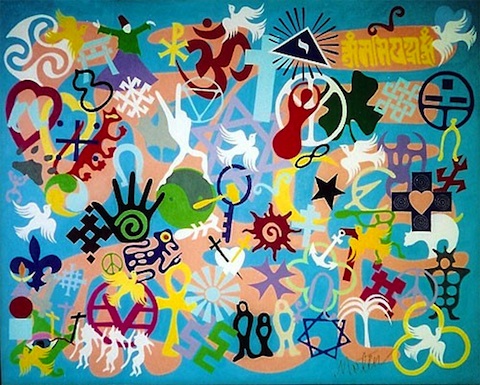
What does it mean to live in a multicultural society? Few questions have
been posed more sharply by the events of the past year from the riots in Bradford,
Burnley and Oldham to the aftermath of the events of September 11.
There have, in recent months, been two broad responses to this question. For
some the violence between whites and Asians in the northern mill towns, and
the seeming rejection by some British Muslims of the core values of their
chosen country, all reveal the failure of the liberal dream of cohesive, tolerant
multicultural society. Writing in the Spectator, Enoch Powell's biographer
Simon Heffer suggested that Powell's forebodings about the future of Britain
have been borne out. Powell's infamous 'rivers of blood' speech, Heffer wrote,
'can, and should, be seen as the first blast of the trumpet against the dangers
of multiculturalism'.
Despite Heffer's advocacy, Powell's little Englander attitudes carry little
currency these days. The dominant view is that the events of the past year
reveal even more clearly the need for a tolerant multiculturalism, in which
all people can enjoy their own culture, while respecting those of others.
Both these responses are, I believe, flawed. One embodies a vision of British
(or, more usually, English) identity pickled in aspic. It is a notion of identity
rooted in John Major's bucolic vision of 'old maids on bicycles and cricketers
playing on the village green'. The other response has abandoned the very notion
of a common identity or of shared values except at a most minimal level. Britishness
is simply the toleration of cultural diversity.
What both sides in the debate fail to recognise is that shared values and
common identities can only emerge through a process of political dialogue
and struggle, a process whereby different values are put to the test, and
a collective language of citizenship emerges. Shared values cannot, as Heffer
believes, be rooted in a mythical past, in an England that does not exist
and probably never did. But the wrongness of the Powellite argument does not
make the proponents of multiculturalism right. A cohesive notion of citizenship
cannot be based simply on the idea that we should respect other people's values.
It requires a positive articulation of the values to which we should all aspire.
In December both the home secretary David Blunkett, and a raft of reports
on the inner city riots, attempted to address this problem of 'Britishness'.
Blunkett suggested that immigrants should be required to speak English and
urged ethnic minorities to become 'more British'. The Home Office-sponsored
report into the riots, chaired by Ted Cantle, recommended that all immigrants
be required to swear an 'oath of allegiance' to Britain. David Ritchie, author
of the independent report on the Oldham riots, criticised the 'self-segregation'
of ethnic minorities, and the failure of ethnic minority leaders to encourage
greater integration.
This castigation of minorities misses the point. The Asian youth who rioted
in Oldham, Burnley and Bradford probably spoke better English than the white
youth who threw petrol bombs. And the white youth were undoubtedly as alienated
from any notion of Britishness as were the Asians. The problem is not that
ethnic minorities are alienated from a concept of Britishness but that there
is today no source of Britishness from which anyone - black or white - can
draw inspiration.
The belief that the problem of race relations in Britain revolves around the
question of the 'difference' of ethnic minorities has been at the heart of
policy debate throughout the postwar period, and is at the heart of the arguments
of both multiculturalists and their critics. The two sides in the multiculturalism
debate have very different views of the Britain they wish to see. Both agree,
however, that Britain has become a multicultural nation because immigrants
(and their children) have demanded that their cultural differences be recognised
and be afforded respect. Supporters of multiculturalism urge the state to
see such diversity as a public good; opponents use it to make a case against
immigration and, in some cases, for repatriation. I want to show, however,
that multiculturalism, far from being a response to demands from local communities,
was imposed from the top, the product of government policies aimed at diffusing
the anger created by racism.
To understand this better, we need to look again at the history of postwar
race relations policy in Britain. The arrival of large numbers of black immigrants
in the 1950s from India, Pakistan and the Caribbean created conflicting pressures
on policy-makers. While they welcomed the influx of new labour, there was
at the same time considerable unease about the impact that such immigration
may have on traditional concepts of Britishness. As a Colonial Office report
of 1955 observed, 'a large coloured community as a noticeable feature of our
social life would weaken... the concept of England or Britain to which people
of British stock throughout the Commonwealth are attached'.
Even in the fifties, though, it was clear that such a simple notion of Britishness
could not be sustained for long. For a start, it was a form of national identity
rooted in a Britain and in an Empire that was already crumbling. Moreover,
the experience of Nazism and the Holocaust had rendered virtually unusable
the kind of racial exclusiveness embodied in this notion of national identity.
In any case, by the end of the fifties black immigrants were already a fact
of life in British. Despite the continued attempts by politicians from Enoch
Powell to Margaret Thatcher to Norman Tebbit to formulate a racially exclusive
concept of Britishness, it was already apparent by the end of the fifties
that British identity would have to be reformulated to include the presence
in this country of black citizens.
In the 1960s, therefore, policy-makers embarked on a new 'twin track' strategy
in response to immigration. On the one hand they imposed increasingly restrictive
immigration controls specifically designed to exclude black immigrants. On
the other they instituted a framework of legislation aimed at outlawing racial
discrimination and at facilitating the integration of black communities into
British society.
The twin track strategy helped promoted the idea of Britain as a tolerant,
pluralistic nation that was determined to stamp out any trace of discriminatory
practice based on racial or ethnic difference. Britain, in the words of Labour
home secretary Roy Jenkins, set out to create 'cultural diversity, coupled
with equal opportunity, in an atmosphere of mutual tolerance'. At the same
time, though, the linking of immigration and integration implied that social
problems arose from the very presence in Britain of culturally-distinct immigrants.
As the (liberal) Tory shadow home secretary Reginald Maudling put it in a
parliamentary debate in 1968, 'The problem arises quite simply from the arrival
in this country of many people of wholly alien cultures, habits and outlooks.'
From the beginning, then, the problem of race relations was viewed not as
one not so much of racial discrimination, but rather of cultural differences,
and of the inability of black immigrants to be sufficiently British.
While the question of integration and of cultural differences preoccupied
the political elite, it was not a question that particularly troubled black
Britons. First generation black immigrants were concerned less about preserving
cultural differences than about fighting for political equality. They recognised
that at the heart of the fight for political equality was a commonality of
values, hopes and aspirations between blacks and whites, not an articulation
of unbridgeable differences.
Throughout the sixties and seventies, three big issues dominated the struggle
for political equality: opposition to discriminatory immigration controls;
the fight against racist attacks; and, most explosively, the issue of police
brutality. These struggles politicised a new generation of black activists
and came to an explosive climax in the inner city riots of the late seventies
and early eighties. The authorities recognised that unless black communities
were given a political stake in the system, their frustration could threaten
the stability of British cities. It was against this background that the policies
of multiculturalism emerged.
Local authorities in inner city areas, led by the Greater London Council,
pioneered a new strategy of making black communities feel part of British
society by organising consultation with black communities, drawing up equal
opportunities policies, establishing race relations units and dispensing millions
of pounds in grants to black community organisations. At the heart of the
strategy was a redefinition of racism. Racism now meant not simply the denial
of equal rights but the denial of the right to be different. Black people,
many argued, should not be forced to accept British values, or to adopt a
British identity. Rather different peoples should have the right to express
their identities, explore their own histories, formulate their own values,
pursue their own lifestyles. In this process, the very meaning of equality
was transformed: from possessing the same rights as everyone else to possessing
different rights, appropriate to different communities.
The multicultural approach appears to be a sensitive response to the needs
of black communities. In fact it is undergrid by the same assumption that
has dogged the debate about race relations from the start: the idea that black
people are in some way fundamentally different from 'British' people and that
the problem of race relations is about how to accommodate these 'differences'.
By the mid-eighties the political struggles that had dominated the fight against
racism in the sixties and seventies had became transformed into battles over
cultural issues. Political struggles unite across ethnic or cultural divisions;
cultural struggles inevitably fragment. Since state funding was now linked
to cultural identity, so different groups began asserting their particular
identities ever more fiercely. The shift from the political to the cultural
arena helped entrench old divisions and to create new ones.
The city of Bradford provides a very good example of how the institutionalisation
of multiculturalism undermined political struggles, entrenched divisions and
strengthened conservative elements within every community. In April 1976,
24 people were arrested in pitched battles in the Manningham area of Bradford,
as Asian youth confronted a National Front march and fought police protecting
it. It was seen as the blooding of a new movement. The following year the
Asian Youth Movement was born. The next few years brought further conflict
between black youth and the police, culminating in the trial of the Bradford
12 in 1981. Twelve young Asians faced conspiracy charges for making petrol
bombs to use against racists. They argued they were acting in self-defence
- and won. Faced with this growing militancy, Bradford council drew up GLC-style
equal opportunity statements, established race relations units and began funding
black organisations. A 12-point race relations plan declared that every section
of the 'multiracial, multicultural city' had 'an equal right to maintain its
own identity, culture, language, religion and customs'.
By the mid-eighties the focus of anti-racist protest in Bradford had shifted
from political issues, such as policing and immigration, to religious and
cultural issues: a demand for Muslim schools and for separate education for
girls, a campaign for halal meat to be served at school, and, most explosively,
the confrontation over the publication of The Satanic Verses. This process
was strengthened by a new relationship between the local council and the local
mosques. In 1981, the council helped set up and fund the Bradford Council
of Mosques. By siphoning resources through the mosques, the council was able
to strengthen the position of conservative religious leaders and to dampen
down the more militant voices on the streets. As part of its multicultural
brief to allow different communities to express their distinct identities,
the council also helped set up two other religious umbrella groups: the Federation
for Sikh Organisations and the Vishwa Hindu Parishad, both created in 1984.
The consequence was to create divisions and tensions within and between different
Asian communities as each fought for a greater allocation of council funding.
There had always been residential segregation between the black and white
communities in Bradford, thanks to a combination of racism, especially in
council house allocation, and of a desire among Asians to find protection
in numbers. But within Asian areas, Muslims, Sikhs and Hindus lived cheek
by jowl for much of the postwar period. In the eighties, however, the three
communities started dividing. They began increasingly to live in different
areas, attend different schools and organise through different institutions.
New council-funded community organisations and youth centres were set up according
to religious and ethnic affiliations. By the early nineties even the Asian
business community was institutionally divided along community lines with
the creation in 1987 of the largely Hindu and Sikh Institute of Asian Businesses;
of the Hindu Economic Development Forum in 1989; and of the Muslim-dominated
Asian Business and Professional Club in 1991. The Asian Youth Movement, the
beacon in the 1970s of a united struggle against racism, split up, torn apart
by such multicultural tensions.
Multiculturalism was not simply the product of demand from black communities
for their cultural differences to be recognised. That demand itself was created
through official policy in response to the black militancy of the 1970s and
early 1980s. Instead of tackling head-on the problems of racial inequality,
social deprivation and political disaffection, the authorities, both national
and local, simply encouraged communities to pursue what the Cantle report
calls 'parallel lives'.
In places like Bradford, Oldham and Burnley multiculturalism has helped segregate
communities far more effectively than racism. Racism certainly created deep
divisions in these towns. But it also helped generate political struggles
against discrimination, the impact of which was to create bridges across ethnic,
racial and cultural divisions. Multiculturalism, on the other had, has not
simply entrenched the divisions created by racism, but made cross-cultural
interaction more difficult by encouraging people to assert their cultural
differences. And in areas where there was both a sharp division between Asian
and white communities, and where both communities suffered disproportionately
from unemployment and social deprivation, the two groups began to view these
problems through the lens of cultural and racial differences, blaming each
other for their problems. The inevitable result were the riots into which
these towns descended last spring.
The real failure of multiculturalism is its failure to understand what is
valuable about cultural diversity. There is nothing good in itself about diversity.
It is important because it allows us to compare and contrast different values,
beliefs and lifestyles, make judgements upon them, and decide which are better
and which worse. It is important, in other words, because it allows us to
engage in political dialogue and debate that can help create more universal
values and beliefs. But it is precisely such dialogue and debate, and the
making of such judgements, that multiculturalism attempts to suppress in the
name of 'tolerance' and 'respect' - as for example in David Blunkett's attempt
to outlaw incitement to religious hatred. The result is not a greater sensitivity
to cultural differences but an indifference to other peoples' lives, an indifference
that lies at the heart of the 'parallel worlds' inhabited by different communities
in towns like Bradford, Burnley and Oldham.
Cultural diversity only makes sense within a framework of common values and
beliefs that enable us to treat all people equally. And to create such a framework
requires us to be a bit more intolerant and to show a bit less respect.