In the autumn of 1951 Isaiah Berlin wrote an essay in the Jewish Chronicle
putting the case for Zionism. Until the founding of Israel, he observed, no
Jew had been free to live a purely Jewish life, free from scrutiny and repression.
Berlin was particularly scathing about Gentile intellectuals, such as the
poet TS Eliot, those 'souls filled with terror' who feared that a Jewish presence
undermined Christian civilisation.
When Eliot protested that he was no anti-Semite, Berlin was sharp in his rebuke.
'Am I profoundly mistaken', he wrote to Eliot, 'that you thought it a pity
that large groups of "free thinking Jews" should complicate the
lives of otherwise fairly homogenous Anglo-Saxon Christian communities? And
that it were better otherwise? And that if this could be done by humane means,
and persuasion and without coercion, it would be better for such communities
if their Jewish neighbours, or a sufficiently large proportion of them, were
put "beyond the borders of the city?" .
'
Forty years later Berlin was interviewed by the political philosopher Steven
Lukes. Was it possible, Lukes asked, for peoples of different cultures, such
as Arabs and Jews, to live together? 'When you have two peoples of different
origins and cultures', Berlin replied, 'it is difficult for them to live together
in peace... it is quite natural that each side should think that they cannot
lead free lives in an integrated society if the others are there in quantity.'
Black immigration to Western Europe was 'a problem' because 'cultures which
have grown up with no contact with one another have now collided'. These considerations,
Berlin observed, had led him to question 'the 19th century [idea] that multicultural
societies were desirable'.
Berlin, who died last year, has come to be seen as the pre-eminent philosopher
of modern liberalism. Yet, as his interview with Steven Lukes reveals, Berlin's
liberalism was highly ambiguous. The defence of pluralism all too easily gave
way to a desire to exclude minorities. A cynic might argue that the difference
between Eliot and Berlin was less about whether minorities should be put 'beyond
the borders of the city' than about which minorities should be so excluded.
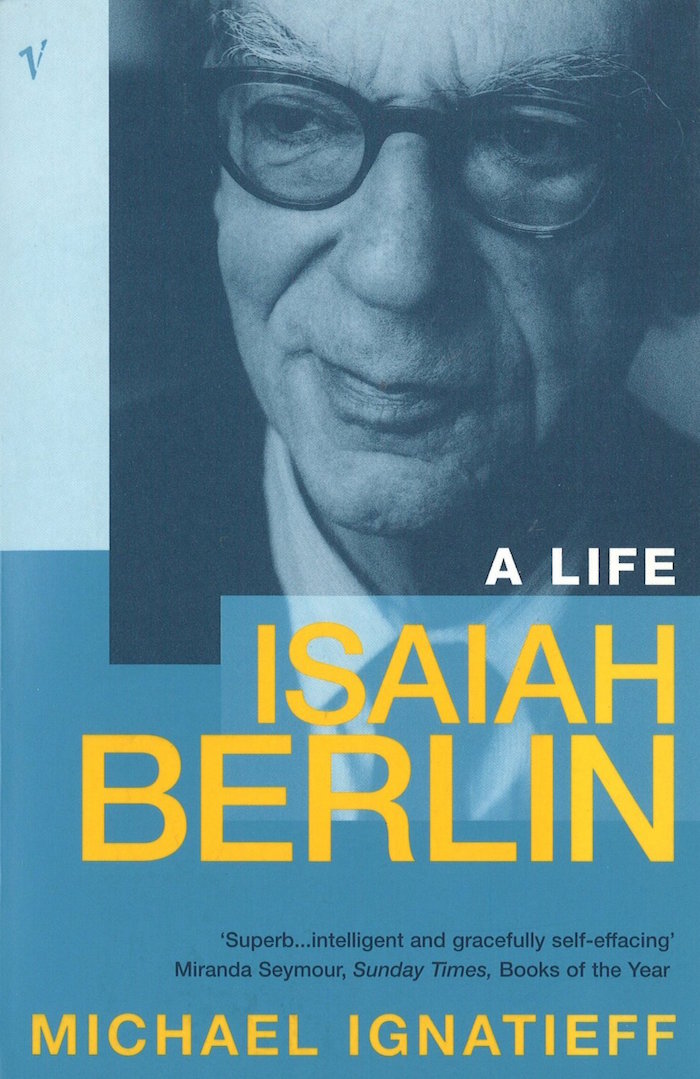
There are few people better equipped to chew over these problems than Michael
Ignatieff. The ambiguities of pluralism and the contradictoriness of identity
have been issues central to much of his work. For the last decade of Berlin's
life, the two men held regular conversations in which Berlin reminisced at
length about his life and work. The result is an intelligent and sympathetic
biography. But while Ignatieff is not blind to the inconsistencies of Berlin's
philosophy, his affection for the man, and empathy for his ideas, constrains
his ability fully to explore its more problematic aspects.
Isaiah Berlin was born in Riga, on the Baltic coast, in 1909, into a virtually-assimilated
Jewish family. His father Mendel was a timber merchant who, as a member of
the business elite, exempted from the restrictive laws that applied to lesser
Jews. With the coming of the First World War, however, this secure, ordered
life was pitched into turmoil. The family was forced to flee, first to Petrograd
and then, following the Bolshevik revolution, to London.
The young Isaiah took to English life with all the fervour of a convert. On
his first morning in England, Ignatieff relates, Isaiah ate an English breakfast,
a defiantly non-kosher plate of bacon and eggs. Then the 12-year old boy went
over to the piano in the hotel salon and, with one hand, picked out 'God Save
the King'. This might be an apocryphal story, but it reveals both the intensity
of Berlin's desire to become English, and the ease with which he did so. So
much so, in fact, that William Waldegrave wrote after his death that 'if you
had asked me to show you what I meant by the ideal of Englishness... I would
have taken you to see Isaiah Berlin.'
Waldegrave had been a colleague of Berlin's at All Soul's College, Oxford,
to which Berlin was elected as a Fellow after his graduation from Corpus Christi.
All Soul's provided Berlin with his entry into the upper echelons of English
social and academic life and the social network with which he surrounded himself
for the rest of his life. But however English Berlin might have seemed, it
was his early East European experiences that shaped the dominant themes of
his work - in particular his opposition to Soviet tyranny and his commitment
to a Jewish identity.
The first of these themes gave rise to Berlin's trenchant defence of liberty
as a good in itself and his distaste for 'Utopian' schemes. The second led
to his deep-seated belief in the need for people to 'belong' to a group and
in the importance of history and tradition in people's lives. Berlin was one
of the few modern liberal philosophers sympathetic to nationalist yearnings.
In the fifties - after a war spent working for the Foreign Office in Washington
and a brief time as a British official in the Soviet Union - Berlin expanded
these themes in a series of lectures and essays, including 'Two Concepts of
Liberty' and 'Historical Inevitability'. For many, the two dominant themes
in Berlin's philosophy seemed horribly at odds with each other. How was it
possible to have a commitment to individual liberty and also be sympathetic
to the idea that individuals should aspire to a group identity? For Berlin,
however, such contradictions were inevitable because contradiction was the
very essence of the human condition. Liberty and fraternity, for instance,
were both desirable, but each undermined the other and one always had to make
choices between them. Moreover, Berlin believed, conflicts between different
political goals arose from the contradictory nature of the human psyche itself.
Humans by nature desired conflicting goals and freedom, in part, was the freedom
to choose between conflicting desires.
For Ignatieff, it is Berlin's acceptance of the conflicting nature of human
desire that makes him a truly great and humane thinker. For both men the human
condition is tragic in the sense that the achievement of one aim always entails
a loss somewhere else.
But what if the contradictions lie not in the human condition but in Berlin's
own philosophy? And what if tragedy is the consequence, not the cause, of
the kind of contradictory politics he espoused? Ignatieff does not explore
these questions too deeply. But they are key to understanding Berlin's work.
Their significance becomes clearer if we consider more closely Berlin's attachment
to Zionism.
Unlike many Zionists, Berlin did not fool himself that that Israel was founded
by a 'people without land on a land without people'. He acknowledged that
the land was already occupied by Palestinians who had suffered grievously
as a consequence of the establishment of Israel. This might be seen as one
of the insoluble conflicts in human life, a conflict between the desire of
Jews, six million of whom had been murdered in the Holocaust, to establish
a safe haven and the aspiration of Palestinians to live, with full national
rights, in their homeland. But the problem here was not that an individual,
or a community, had to make a choice between two desirable aims. It was that
for one people to realise their dreams, another had to lose everything. As
a consequence of the creation of Israel, millions of Palestinians were expelled
from their homeland; those that stayed were deprived of many of their basic
rights.
Berlin's solution to this conundrum was to argue for the establishment two
states, one for Jews, one for Palestinians. But as the current peace process
reveals, the two state solution, far from minimising conflict between Palestinians
and Jews, has entrenched and, indeed, intensified it. And therein lies the
fundamental problem of Berlin's pluralist philosophy: it encourages people,
to search for differences between them, rather than frame their identities
around what they might have in common. As Berlin's interview with Steven Lukes
suggests, there is a thin line between viewing people as different and viewing
people as unacceptably different, so different that they must be put 'beyond
the borders of the city'.
One solution to the problem might be to encourage people to recognise their
commonalities rather than celebrate their differences. Berlin, however, deemed
such a solution 'Utopian'– the attempt artificially to engineer solutions
to irresolvable human problems. His experience of the Bolshevik revolution
had set him against any form of social engineering or political 'fanaticism'.
But this often amounted simply to distaste for political action. There was
an element of truth to EH Carr's complaint that a thinker who warned against
the dangers of strong belief was unlikely to believe anything very much at
all. Berlin's refusal to take a clear public stand over issues such as McCarthyism
or the Vietnam War - preferring, in his own words, to be safe in his Oxford
college, 'sublimely unaware of the outside world' - appalled his more radical
friends. Given this distaste for political action, it was almost inevitable
that Berlin would see human conflicts are irresolvable.
Berlin's pluralism and his hostility to political commitment were considerably
more problematic than many people, including Ignatieff himself, acknowledge.
His commitment to individual freedom, however, remains unquestionably important.
For Berlin, history was not the product of vast impersonal forces, but the
result of human action. Out of human beings' capacity to make their own history
arose human freedom. Particularly important was Berlin's distinction between
positive and negative liberty. The best way to entrench freedom, Berlin insisted,
was to free people from obstacles to the exercise of their own free choice,
not to tell them how to use their own freedom.
Berlin's stress on the importance of freedom often led him into indiscriminate
denunciations of 'historical determinism', believing as he did that all theories
of historical development denied the notion of free will. But however crass
such arguments were, there can be no questioning the significance of his defence
of freedom. Human beings, Berlin believed, had the capacity to face the truth
and make their choices even in the darkest of moments. This is why, he wrote,
the deception of Nazi officials who persuaded Jews into cattle trucks by assuring
them that they were being 'resettled' was so pernicious. The deception may
have 'diminished the anguish of the victims' but it nevertheless produced
an 'unutterable kind of horror in us': 'We cannot bear the thought of human
beings denied their last rights - of knowing the truth, of acting with at
least the freedom of the condemned, of being able to face their destruction
with fear or courage, according to their temperaments, but at least as human
beings, armed with the power of choice.'
Living as we do in an age in which freedom is often circumscribed under the
pretext of 'protecting' the individual, Berlin's argument has become particularly
apposite. It is the case for the importance of human freedom, rather than
the claims for the divided human self, which is likely to be Isaiah Berlin's
lasting legacy.