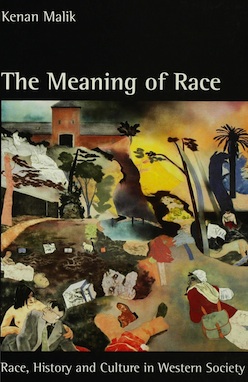


The Meaning of Race:
Race History and Culture in Western Society
(Macmillan / New York University Press, 1996)
The Meaning of Race has two key themes. First it explores the
intellectual and philosophical basis of racial thinking, examining the origins
and development of the concept of race from the Enlightenment to the present
day. Second, it also looks at the way in which recent social and political
developments - such as the end of the Cold War, the erosion of the postwar
liberal consensus, and the demise of the left - have shaped our ideas about
race.
Controversially, the book argues that much of contemporary antiracism is
rooted in the same antihumanist philosophies of human differences that gave
rise to the idea of race in the first place.Only a philosophy based on a
universalist and humanist outlook, I suggest, can hope to transcend the
discourse of race.
‘An important,
cogent and illuminating book…brilliantly ambitious.'
AC Grayling, Financial Times
‘A work of prodigious learning’
Sam Pryke, Sociological Review
'If you believed The Bell Curve, this book will change your mind.’
Steve Jones
‘A must-read book…’
Yasmin Alibhai-Brown, Independent
'Important and readable'
Desmond King, THES
‘Kenan Malik’s arguments are articulate and controversial; his
approach demands thought and attention.’
Paul Macey, The Voice

Journal of Ethnic and Migration Studies, vol24, no1 (1998)
Ethnic and Racial Studies, vol20, no2 (1998)
Sociological Review, vol45, no2 (1997)
'The colour purpose', by Desmond King, Times Higher Education Supplement,
21 March 1997
'Collected works', by Beulah Ainley, New Scientist, 1 February
1997
'Hue and cry' by Stephen Howe, New Statesman, 13 December 1996
'Pluralism or equality: A review', by Kaushika Amin, Runnymede Trust
Bulletin, November 1996
'Time for another social revolution', by AC Grayling, Financial Times,
10&11 August 1996

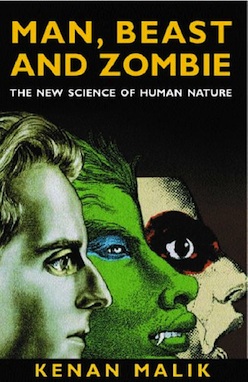
Are humans just animals? Are minds just machines? And what
does it say about our age that such ideas appear both scientifically plausible
and culturally acceptable? These are the issues at the heart of Man,
Beast and Zombie.
In the book, I question the ways in which we understand what it means
to be human, both scientifically and culturally. Recent advances in evolutionary
biology, neuroscience, genetics and AI seem to make possible the understanding
of humans as simply animals or machines. I argue that this is an illusion
fostered by a culture that is deeply pessimistic in its view of human
beings. A century's worth of bloodshed and barbarism has created disillusionment
with human capacities and opened the way for a science that views humans
as beasts or zombies.
Man, Beast and Zombie is in part an exploration of scientific
arguments about human nature, and in particular of evolutionary psychology
and cognitive science. In part it is a study of cultural history, of the
impact of intellectual and cultural changes on scientific conceptions
of the human. And, in part, it is an attempt to understand the philosophical
framework within which the contemporary science of Man works.
Through a discussion of historical figures such as Descartes, Darwin,
Spencer, Konrad Lorenz, Franz Boas and Margaret Mead, and of contemporary
thinkers like Richard Dawkins, EO Wilson, Stephen Jay Gould, John Searle,
Daniel Dennett and Peter Singer, I provide a critique both of the contemporary
science of human nature and of the culture that has given rise to it.
Man, Beast and Zombie is published in Britain by Weidenfeld &
Nicolson and in America by Rutgers University Press. In Holland it is
published by Lifetime as De Mens, het Beest en de Zombie.
’The most
insightful and thoughtful account of the contemporary claims of science.
Not least Kenan Malik is a most accomplished writer’
Roy Porter
‘A ray of common sense in a fog of pseudoscience. Kenan Malik‘s
brilliant book cuts through the prejudice and plain ignorance that surrounds
sociobiology to show what science can and cannot say about ourselves.'
Steve Jones
‘Man, Beast and Zombie is wonderfully written (there is
not a duff sentence in its 480 pages), rigorously argued, witty, knowledgeable
and balanced in its judgements.’
Raymond Tallis, Prospect
‘He manages to convey an amazing range of controversial history
in a style that is always clear, sharp and eloquent... A helpful and important
book.’
Mary Midgley, London Evening Standard
'A rich and highly educative book which takes us through a wealth
of fascinating ideas, and offers us a plausible and deeply humane set
of conclusions at the end.’
AC Grayling, Independent on Sunday
’An admirable, truly humanist work.
Noga Arikha, TLS
‘Malik’s critique of man-as-beast and man-as-zombie is as
deep as it is broad, and impressively self-assured… We need more
people like him.’
Christian Tyler, Financial Times
‘Lucid and reasonable….’
Jonathan Ree, Independent
'Scholarly and well-written… the best of all attempts to see what
science has to say on this broad subject.’
Marcin Szwed, HMS Beagle

Review
by Keith Harris, Metapsychology Online, 23 April 2003
'Een
academische oorlog' by Maarten Derksen, De Academische Boekengids
(Holland),
No 32, April 2002
Review
by Jean-Paul Baquiast, Les automates intelligents. 9 April 2001
Review by Marcin Szwed, Endeavour, vol26, no1 (2002)
'Undermining
Man' by Noga Arikha,TLS, 9 February 2001
'Against
Dr Panglum' by Ray Tallis, Prospect, February 2001
'Peace for political animals' by Jonathan Ree, Independent, 16
December 2000
'Losing both soul and self' by Hugh Lawson-Tancred, Spectator,
2 December 2000
'War of the world views' by Bob Tait, Glasgow Herald, 18 November
2000
'Whatever happened to free will and reason?' by John Cornwell,
Sunday Times, 12 November 2000
'The owl of Minerva flies at dusk' by Bryan Appleyard, Literary Review,
November 2000
'Taking the beast out of mankind' by Mary Midgley,
London Evening Standard, 23 October 2000
'Scary monsters' by Hugo Barnacle, New Statesman, 23 October
2000
'Reclaiming humanism' by AC Grayling, Independent on Sunday,
22 October 2000
'Just fancy chimps with attitude?' by Christian Tyler, Financial Times,
21&22 October 2000
'How different are humans?' by Anthony Daniels, Sunday Telegraph,
15 October 2000

‘I am inherently gloomy about the prospect of Africa… All
our social policies are based on the fact that their intelligence is the
same as ours – whereas all the testing says not really.’
So claimed the Nobel Laureate, James Watson, in an interview in Britain’s
Sunday Times in October 2007. Watson is one of the most eminent
living scientists. In 1953, he and Francis Crick unravelled the extraordinary
double helix structure of DNA, perhaps the single most important scientific
breakthrough of the twentieth century. For forty years he was director
of the Cold Spring Harbor Laboratory on Long Island, New York, one of
the most prestigious biological research institutions in the world. He
was also director of America’s Human Genome Project, until he resigned
over plans to patent genes, to which he was passionately opposed.
But Watson also has a darker reputation. He has been mired in controversy
throughout his life, such as when he claimed a link between skin colour
and libido or seemed to suggest that it might be right to abort ‘gay’
foetuses (he later insisted that his words had been taken out of context).
The journal Science once said of him that ‘To many in the
scientific community, Watson has long been something of a wild man, and
his colleagues tend to hold their collective breath whenever he veers
from the script.’
The Sunday Times interview was one of several that Watson had
given to promote his autobiography called, perhaps unsurprisingly, Avoid
Boring People. Despite the title, the book is quite bland. Watson
refers to the issue of race only briefly and obliquely. ‘There is
no firm reason’, he writes, ‘to anticipate that the intellectual
capacities of people geographically separated in their evolution should
prove to have evolved identically. Our wanting to reserve equal powers
of reason as some universal heritage of humanity will not be enough to
make it so.’ In the Sunday Times interview, conducted by
his former student Charlotte Hunt-Grubbe, Watson translated the careful
wording of the book into the language of the street. People expect everyone
to be equal, he claimed, but ‘people who have to deal with black
employees find this is not so.’
Censure was swift and universal. Steven Rose, professor of biology at
the Open University, condemned the comments as ‘scandalous’.
The Mayor of London, Ken Livingstone, fulminated against ‘ignorant
comments’ that ‘are utterly offensive and give succour to
the most backward in our society.’ Britain’s newly-formed
Equality and Human Rights Commission studied the remarks to see if it
could bring any legal action. London’s Science Museum, at which
Watson was to have delivered a lecture, cancelled his appearance, claiming
that the Nobel Laureate had ‘gone beyond the point of acceptable
debate.’
In America, too, the criticism was almost total. The Federation of American
Scientists condemned Watson for choosing ‘to use his unique stature
to promote personal prejudices that are racist, vicious and unsupported
by science.’ Francis Collins, director of the National Human Genome
Research Institute, described Watson’s comments as ‘racist’
and as both ‘profoundly offensive and utterly unsupported by scientific
evidence.’ Cold Spring Harbor Laboratory not only ‘vehemently’
disowned Watson’s remarks but suspended his chancellorship of the
institution, forcing him eventually to resign.
The row over Watson’s comments shows all that is wrong with the
current debate about race. On the one hand, Watson got his facts in a
double helix. On the other, the arguments of Watson’s critics were
equally in a twist. There are certainly real genetic differences between
human populations and the scientific study of these differences can help
unravel the roots of disease, develop new medicines, unpick the details
of deep human history; perhaps eventually even tell us something about
the nature of intelligence. Such genetic differences are, however, not
the same as racial differences. Race provides a means, not just of categorising
humanity, but also of imputing meaning to those categories and of selecting
certain categories, based on skin colour, appearance, or descent, as being
of particular importance. Racial thinking divides human beings into a
small set of discrete groups, sees each group as possessing a fixed set
of traits and abilities and regards the differences between these groups
as the defining feature of humanity. All these beliefs run counter to
scientific views of population differences.
If Watson’s arguments seemed to show a disregard for the facts of
human differences, those of many of his critics appeared to be indifferent
to the spirit of free inquiry. For the Science Museum, Watson went ‘beyond
the point of acceptable debate’. But what is acceptable debate?
Two years ago, the then Harvard chancellor, Larry Summers, caused outrage
by suggesting, in a speech, that evolved brain differences, rather than
gender discrimination, may explain why men dominate science. Like Watson,
Summers faced condemnation. Like Watson, he had to apologise for his comments.
And like Watson, he was forced eventually to resign his post. The evolutionary
psychologist Steven Pinker was asked whether Summers had put himself beyond
the pale of legitimate academic discourse with his comments. ‘Good
grief’, Pinker exclaimed, ‘Shouldn’t everything be within
the pale of legitimate academic discourse, as long as it is presented
with some degree of rigor? That’s the difference between a university
and a madrassa.’
Of course, there was more than a little lack of rigour to Watson’s
comments. Yet the issue of race, and of the relationship between race
and intelligence, remains the subject of legitimate scientific debate.
Almost on the same day as Avoid Boring People hit the bookshops,
so did Craig Venter’s autobiography, A Life Decoded. Venter
is a geneticist, almost as distinguished as Watson. He was one of the
driving forces behind the Human Genome Project and the founder of Celera,
the private sector biotechnology company without which the unravelling
of human genome would have taken considerably longer. His view on race
is the opposite of Watson’s. ‘The concept of race’,
he writes, ‘has no genetic or scientific basis’. Nor, he suggests,
is there any ‘basis in scientific fact or in the human gene code
for the notion that skin colour will be predictive of intelligence’.
There is, as we shall see in Chapter 2, a growing questioning of the idea
that race has no genetic basis and a burgeoning use of racial categories
in scientific and medical research. Nevertheless, Venter’s argument
broadly accords with the current scientific consensus. It certainly accords
with current moral and political sensibilities. Nevertheless, it is as
legitimate for Watson to express his opinion as it is for Venter to express
his, even if Watson’s appears to be factually wrong, morally suspect
and politically offensive. As in many controversies about the human condition,
the debate about race is less about the facts of human differences than
about the meaning of these facts. It is only through open debate that
we are able to decide which interpretation of the facts is the most meaningful.
A scientific debate that is policed to ensure that opinions do not wander
beyond acceptable moral and political boundaries is no debate at all and
itself loses any meaning.
For many, though, science is political. In recent years, there
has grown a greater scepticism about the idea that science provides an
objective view of the world, a view that is universal and valid across
all societies and cultures. Belief in the objectivity of the scientific
method and the universality of scientific knowledge developed through
the Scientific Revolution of the seventeenth century and the Enlightenment
of the eighteenth. It is a belief that traditionally has been associated
with progressive thought – but no longer. Where radicals once championed
scientific rationalism and Enlightenment universalism, now they are more
likely to decry both as part of a ‘Eurocentric’ project. ‘All
knowledge systems’, the philosopher Sandra Harding has written,
‘including those of modern science are local ones.’ Western
science has taken over the world ‘not because of the greater purported
rationality of Westerners or the purported commitment of their sciences
to the pursuit of disinterested truth’ but ‘primarily because
of the military, economic and political power of European cultures.’
Science, Harding concludes, ‘is politics by other means.’
And if that is the case, then science clearly must be policed for its
moral and political rightness. That is why Watson was sandbagged as much
by moral outrage as by rational argument.
The irony is that, for all the vitriol directed at Watson, racial talk
today is as likely to come out of the mouths of liberal anti-racists as
of reactionary racial scientists. The affirmation of difference, which
once was at the heart of racial science, has become a key plank of the
anti-racist outlook. We’re All Multiculturalists Now observes
the American sociologist Nathan Glazer, in the title of a book. Indeed
we are. The celebration of difference, respect for pluralism, avowal of
identity politics – these have come to be regarded as the hallmarks
of a progressive, anti-racist outlook and as the foundation of a modern
liberal democracy. The paradoxical result, as we shall see, has been to
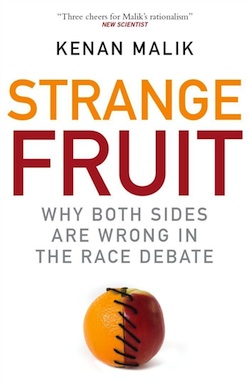
transform racial thinking into a liberal dogma. Out of the withered seeds
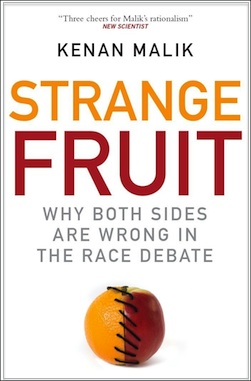
of racial science have flowered the politics of identity. Strange fruit,
indeed.
This book challenges both sides of the race debate. There are three broad
parts to my argument. The first two chapters explore the meaning of race
as a scientific category. Race, I argue, is a social, not a scientific
category, but it is precisely because it is a social category that it
may be useful in scientific and medical research. Chapters 3 to 7 examine
the rise and fall historically of the idea of race and explain its sublimation
into the idea of culture. Chapters 8 to 10 look at the contemporary clash
between claims of scientific rationality and those of cultural identity
and at how much modern liberal thinking has been infected by a racial
view of the world. The final chapter is an afterword on the Watson row,
which re-examines the debate over his comments in light of the argument
in this book.
Race is not a rational, scientific category. Anti-racism has become an
irrational, anti-scientific philosophy. The challenge we face is to confront
racial thinking while defending scientific rationality and promoting Enlightenment
universality. The aim of this book is to do just that.

Sorry, there are no reviews yet
(probably because the book is not published till June)